
Cusco was the capital of the Incas and the Incas worshiped mountains which they called "Apus". These mountains were sacred in the Inca time. There can be found Apu Ausangate near Cusco.
One of the new main attractions of Peru is the Rainbow Mountain near Cusco. This colorful mountain, also known as "Vinicunca Mountain", was an insider tip a few years ago. The rainbow mountains of Cusco and close by are world famous. In fact, there seem to be rainbow mountains somewhere in the mountains of Ausangate. The most famous in Peru are near Vinicunca. Precisely because they are so well known, they are also extremely crowded. Sometimes up to 1,000 tourists are said to romp around there in one day. Apart from the fact that you don't have to follow every trend as a traveler, there are alternatives to experience the impressive Andean landscape from a different perspective and with fewer tourist crowds.
Everyone is talking about it when it comes to traveling to Peru "Vinicunca", also known as Rainbow Mountain. This trip is the most popular for all travelers, but there are two mountains in Ausangate that are not popular and published, but you can enjoy the most beautiful scenic trail, these mountains are Palcoyo Mountain with red river and Pallay Poncho mountain.
Rainbow Mountain Peru
The Cusco's mountains has became new tourist attractions. The most popular mountain is the Rainbow Mountain. The mount is considered one of today's most popular tourist sights. For that reason, there is not many visitors who have not taken its picture.
The Rainbow Mountain Cusco (also called 'Vinicunca' or simply 'Arco Iris') is one of the new and best Peru's attractions. It is located more than 100 kilometers from Cusco City and its summit reaches 5,200 meters above sea level.
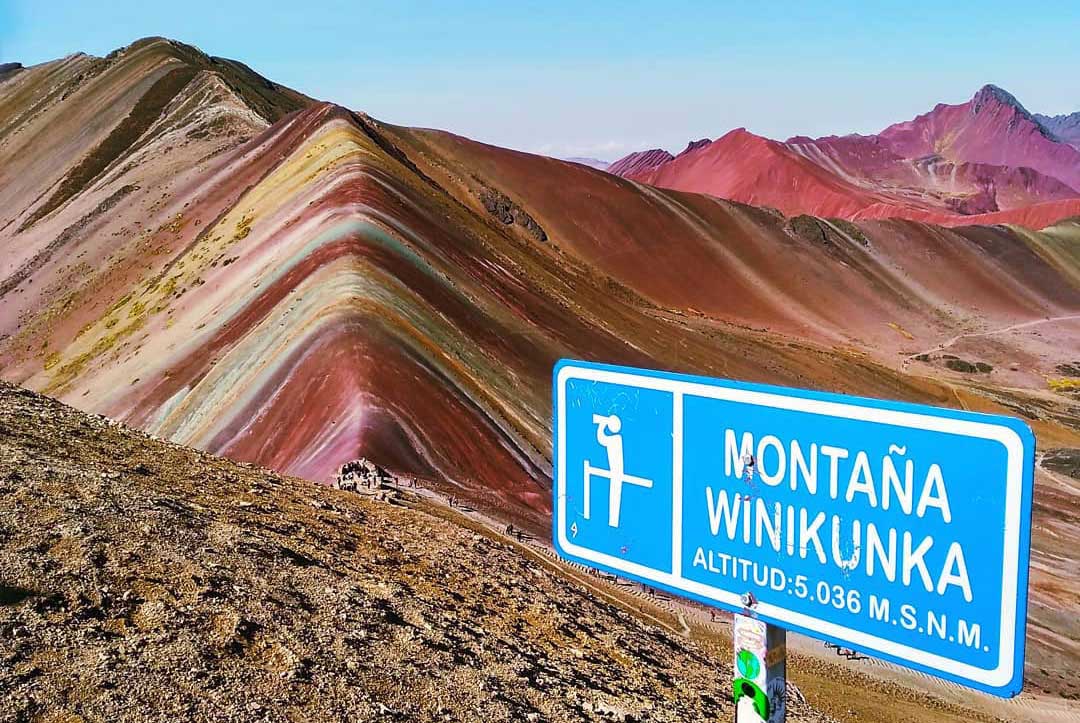
This mountainous formation is colored in various shades which is the product of a complex combination of minerals. Its slopes and summit are 'painted' in a variety of colors including red, purple, green, yellow, pink, and others. Not many years ago, this tourist attraction was covered and surrounded by ice. Since 2016, the place has received hundreds of visitors daily and, along with Machu Picchu, has become one of the most visited places in Cusco - Peru. All details about the Rainbow Mountain Cusco can be found just below.
Location and Height
It is an amazing site placed in the Peruvian Andes, in the department of Cusco, in the Canchis Province. Its elevation reaches 5,200 m.a.s.l. The mountain belongs to the Pitumarca villagers who call it 'Cerro Colorado' (Colourful Mountain). As it is located on the way to imposing Ausangate, this place was known much earlier by adventurers who dared to do the trek there. Their photos published on Facebook and Instagram gained it popularity. It has become a popular tourist sight since 2016.
Palccoyo Mountain
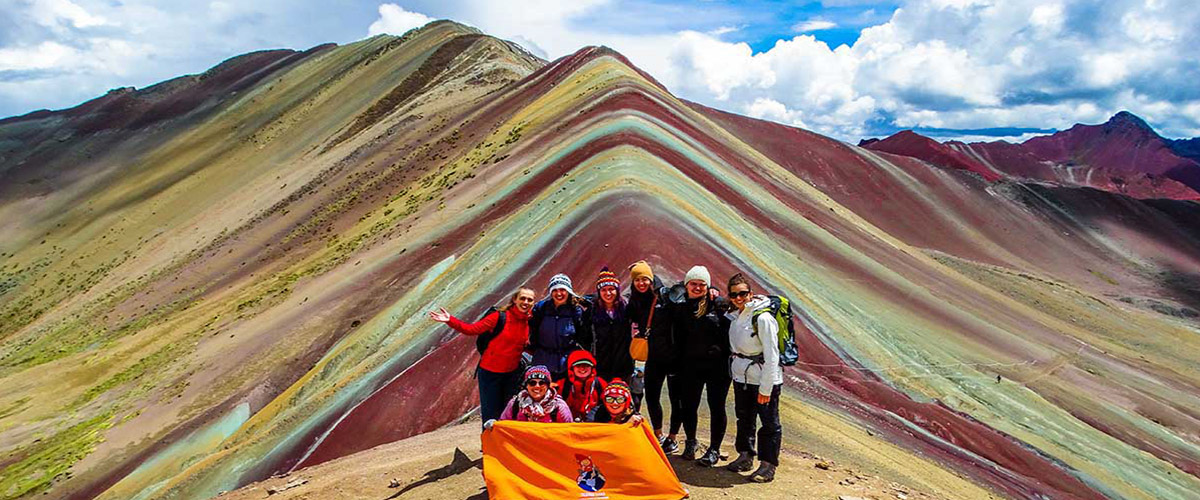
The absolute highlight of these mountains is Palccoyo Mountain. This mountain is a real natural phenomenon waiting to be discovered by all travelers.
The air at this altitude is difficult, but it's worth doing - you start at around 4,300 meters. Although you are well acclimatized, running is more difficult than usual and so you move uphill at a slow but steady pace.
Often you will stop and reward yourself with the view around you. The view of the red-colored earth is just as indescribably beautiful as the small-scale farms or the leisurely grazing alpaca herds at the edge of the path.
Inspired by the sight of the surroundings, continue upwards until you are standing at over 5,000 meters on a narrow ridge full of pinnacles. Now you will have it right in front of your eyes: a firework of colors.
Enjoyed the breathtaking panorama of the rainbow mountain Palccoyo with its colorful stripes, which formed an incredible contrast to the blue sky above you but also to the Red Valley, which was recognizable in the distance. It is difficult to take your eyes off this sight. You will walk around for a long time and up on the ridge to be very close to this wonderful play of colors in nature. Only a handful of travelers get to walk to visit and explore.
You will meet the cutest four-legged friends of Peru such as Alpaca. Sheep and Llamas
Pallay Poncho Mountain
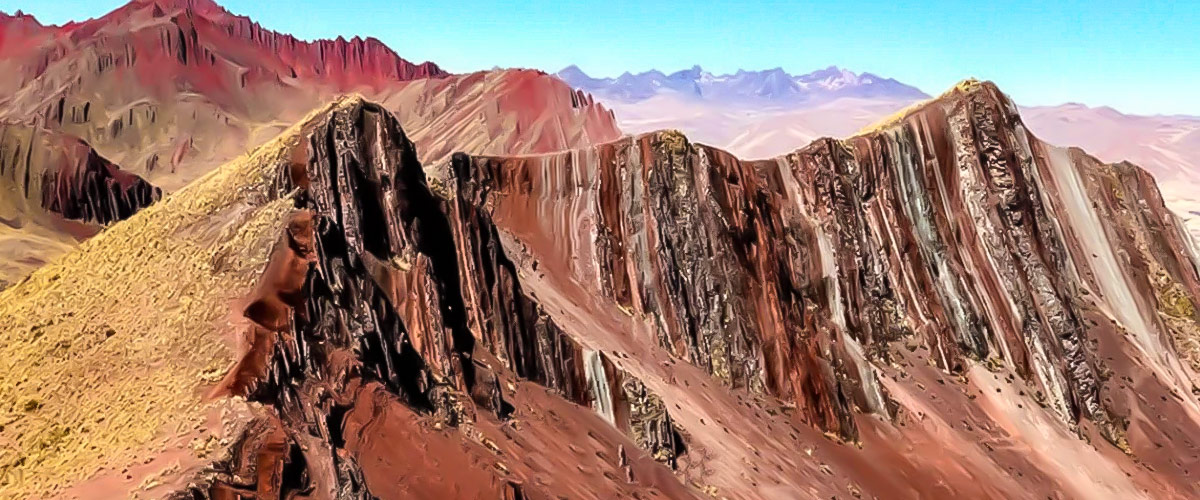
At the time of this pandemic, the community of Layo has discovered a new mountain. Its name is Pallay Puncho Apu Taqllo or the Pallay Poncho Mountain. It is characterized by its stunning colours, sharp points and a beautiful lake nearby. The altitude of the mountain is 4,800 meters above sea level /15,748 feet.
Location and Height
Pallay Poncho Mountain or Pallay Puncho Apu Taqllo is a colourful mountain situated in the Cusco Department, on the border of the Canvas and Canchis Provinces. Between the communities of Layo and Ocobamba. The altitude of this Apu is 4,800 m /15,748.03 ft.
How to Get There?
Rainbow Mountain Cusco
Due to its location, a little over 100 kilometers from the city of Cuzco, the Rainbow Mountain Cusco trip is mostly done by car. After a 2-hour ride on the Longitudinal Highway of the Sierra, the community of Pitumarca appears. The journey continues following a path to the village of Pampa Chiri. From there, a 5-km long route leads your through mountainous slopes. In the end, Vinicunca (Rainbow Mountain) can be seen in all its glory. A visitor can do this route either by foot or on horseback. It is a bit complicated to get there and moreover safe and healthy, So, it is strongly recommended to take a tour there.
Pallay Poncho Mountain Cusco
The mountain is approximately a 4-hour drive away from Cusco. On the way, one needs to reach firstly the city of Sicuani (3,550 m.a.s.l./11,646 f.a.s.l.) and then to continue to the community of Layo.
From there, there are several routes leading to the colourful sector of Apu Taqllo or Pallay Poncho. Some routes are extreme and you may find yourself in a rush to climb them. For that reason, we recommend you to enjoy this adventure in the company of an experienced Tour Guide who knows this area very well.
Weather
The climate is typical for the highest areas of Cusco, this means it is cold. Rain, wind and altitude sickness (or soroche) can be the biggest obstacles for travelers on the way. Temperatures can drop to zero degrees of centigrade. The best time to carry out this adventure is during the dry season (from April to October) when rainfall is less likely. If you plan to visit it during the rainy season (November to March), bring a proper rainy poncho with you.
The Best Time to Visit the Rainbow Mountain and Pallay Poncho
The best season is during the dry season which starts in April and ends in September. In October, rain begins and one might find Machu Picchu covered by clouds. If you travel in June, we recommend you to book the Inti Raymi 2023 Tour, which takes place on the 24th of June, and also hike the Palcoyo Mountain Tour or Pallay Poncho Hike that are other incredible mountains located in the Andes near Cusco.
Flora and Fauna
The overwhelming geographical location of this place offers sceneries with typical high Andean animals such as llamas, alpacas and vicuñas. The locals breed horses to offer them as a mean of transport to tourists.
Tour of the Mountain of the 7 Colours
This picturesque summit used to be an attractive 4-day track to the snow-capped Ausangate Mountain. Over the years, the Mountain of 7 Colours itself has gained popularity. At present, the most common way to visit this summit using a tour. There are 1-day and 2-day options. Tours usually include transportation, food, tickets and a professional Tour Guide. In Cuzco, there are many travel agencies offering the tour.
Trek Difficulty
The walk of 3 to 4 hours (depending on the physical condition of each trekker) is not dangerous and demands a moderate-high physical effort. There are sections of considerable slopes for ascent and descent. However, one of the biggest difficulties is the cold weather and the icy wind. The altitude of the area can cause altitude sickness or soroche. That is why, it is recommended a previous 1-2 day acclimatization in the city of Cusco.
Recommendations
Spend a day or two acclimatizing in Cusco. Wear warm clothes for the trek. If you do not consider yourself physically fit to hike it, rent a horse from one of the locals on the way. On the day of the trek, do not forget a hat or cap, sunscreen, jacket, pants, shoes suitable for trekking and a poncho for rain.
Other Famous Tours in Cusco
There are many routes taking you to Machu Picchu. But none is like the Inca Trail Tours - the most famous pedestrian path of the Americas! After flying from the capital of Peru - Lima, you arrive in Cusco to walk for 4 days following a trail through forests and dense fog, millenary stone steps while discovering the ruins of ancient fortifications and Inca towns. All the time, you might enjoy majestic views. You can pick from the following options:
- Salkantay Trek to Machu Picchu 5 Days
- Hiking the Inca Trail to Machu Picchu 5 Days
- Inca Quarry Trail 4 Days
- 2 Day Inca Trail Tour
- 2 Day Inca Trail with Camping
- 3 Day Inca Trail
- Vilcabamba Hike to Machu Picchu 6 Days
- Choquequirao Trek to Machu Picchu 9 Days
- Ausangate Trek 7 Days
If you like to visit Machu Picchu, we recommend you to book your Machu Picchu Ticket in advance. In this way, you will enjoy your Vacation in Machu Picchu without any problem.


