Write us
#TierrasVivas 437

Sillustani Chullpas: Puno's Mysterious Cemetery

Posted On: 30 December 2025 #TierrasVivas 437
Sillustani Chullpas: Puno's Mysterious Cemetery

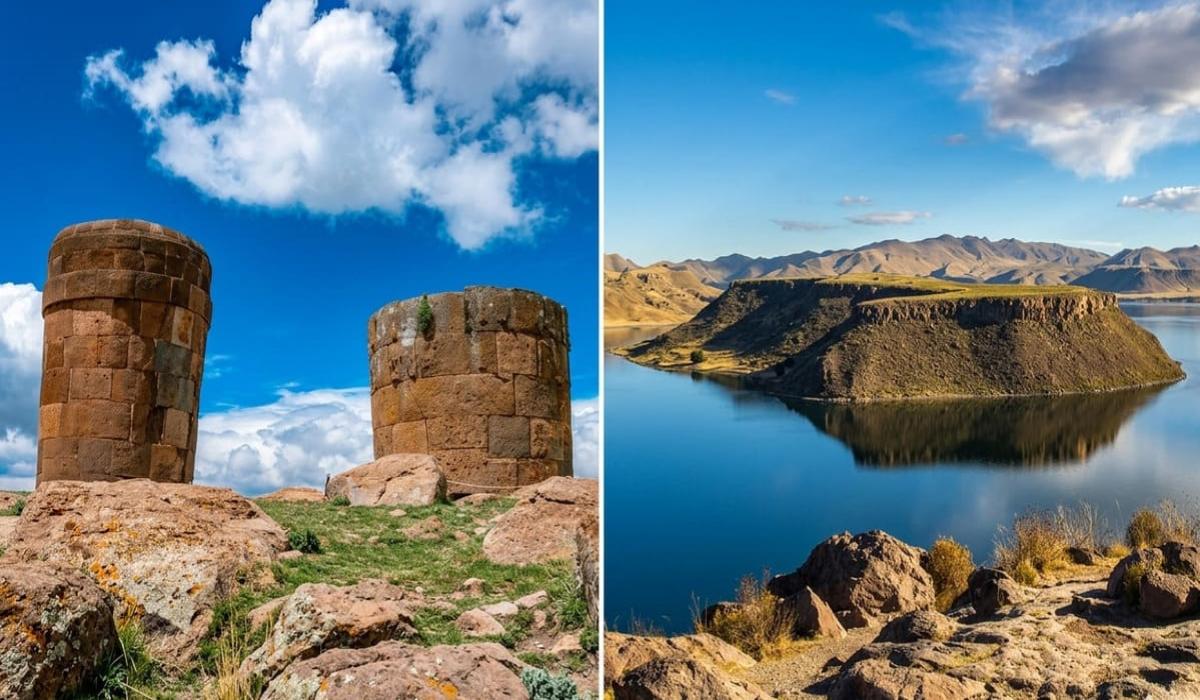
The Sillustani chullpas are located 34 kilometers from the city of Puno, on the peninsula that juts out into the shimmering blue waters of Lake Umayo at 4,000 meters above sea level. This stunning lake, approximately 14 meters deep, is connected to the mainland by the Chaullamayo River to the southwest and the Ccaccapunco River to the north, and is linked to Lake Titicaca by the Illpa River.

Lake Umayo Peninsula

Sillustani has around 90 chullpas shaped like inverted cones. According to local lore, before the bodies of the highest Kolla authorities were placed in the tombs, they were mummified in a fetal position. These authorities were the most representative figures of the Inca Empire.

Their belongings were placed alongside their bodies, a practice intended to maintain, over time, respect for the authorities and all that had characterized them during their reign. Some offerings included gold and silver objects, food, or ceramic utensils.

Chullpas of Sillustani in Puno

The chullpas are located on the top of a small hill. Among the most famous is the Chullpa of the Lizard, named for the large stone blocks at its base. This is the most representative of the culture, as it is the most prominent, rising to a height of 12 meters with perfectly fitted stones. It was also built during the Inca period.

Chullpa of the Lizard, the most famous tomb of Sillustani

How to get to the Chullpas of Sillustani?

To visit the Chullpas of Sillustani, you can take a tour from the city of Puno or a direct public bus from Juliaca to Puno or vice versa. You can also go on your own using the shared taxi or shared taxi located at the Sillustani exit. Entrance to the archaeological site costs S/5.50 (USD 2.00) and it's open from 8:00 a.m. to 5:00 p.m. (approximate hours).

Exploring one of the world's most important necropolises means uncovering great mysteries about how the most important authorities of the Inca Empire were buried and how these sacred places remain so today.

Travel to Puno aboard the PeruRail Titicaca train and don't miss the opportunity to visit the Chullpas of Sillustani, a cemetery as historic as it is mysterious. Get your train tickets now!

Description

Built in the 13th century by the Colla civilization, who occupied this region before the Inca domination, the Sillustani Archaeological Complex is a funerary center comprised of 91 funerary towers of varying dimensions and characteristics, depending on the period in which they were built, the type of structure, size, finish, and ornamentation. It occupies an area of ​​approximately 60 hectares. The space is distributed as follows: The funerary sector, located on the esplanade, is the largest of all and contains the greatest number of chullpas (burial towers). On the slopes of the esplanade are sets of terraces with surface material.

The area where the ritual linked to the funerary function was performed contains remains of structures that served as spaces for ceremonies, such as the solar circles or intihuatanas, the huaca-type monoliths, the Inca Bath, and the access stairway. They were built on a peninsula where the main archaeological structures are located. Its slopes feature corrals, archaeological terraces, and petroglyphs (quilcas) found on the walls and bases of the chullpas, as well as on the rock blocks and outcrops distributed across the upper part of the peninsula, from where Lake Umayo can be seen. The chullpas of Sillustani, known as among the largest and best-crafted in the entire Altiplano, are distinguished by three types: Chullpas with carved blocks, which have uniform, polished, or cushioned surfaces, and do not use mortar or rubble; the floor plan can be circular or quadrangular. Chullpas of irregular masonry, with unworked stone blocks arranged in discontinuous courses and joined with mud mortar, which were part of the Colla culture (Altiplano period). And Chullpas with mud plaster (kaolinite). According to chroniclers, before the bodies of the highest Colla authorities were placed in their tombs, they were mummified in a fetal position. These authorities were the most representative of the empire, and their belongings were placed alongside their bodies. This was done to maintain, over time, respect for these authorities and all that had characterized them during their reign, as they believed in reincarnation. Some of these belongings included gold and silver objects, food, or ceramic utensils.

The most famous is the Lizard Chullpa, named for the lizard carved into the facade of one of the stone blocks. This reptile, abundant in the area, was considered a symbol of life by the ancient inhabitants because of its ability to regenerate its tail.

This chullpa is the most representative of the culture, the most prominent, standing 12 meters tall with a base diameter of 7.17 meters. Each chullpa has an entrance always facing east, which allowed the deceased to communicate directly with the Sun God. This entrance is quite small, leading to the belief that the funerary bundle or mummy was first placed inside the vault, which was then sealed with perfectly fitting stones.

Around the chullpa, archaeological evidence can be seen, including furniture, surface ceramic fragments, and lithics—building materials used for the structures or remains of the buildings themselves, such as ramps. The entire archaeological site spans at least three major cultural periods, from the Tiwanaku era to the Collasuyo period. Architecturally, the buildings correspond to funerary patterns: Colla, Sillustani, and Cusco, which are notable for their Inca characteristics. It was declared a National Cultural Heritage Site in 2003 by the National Institute of Culture.

Tierras Vivas Travel Blog

Edwin Caviedes Profesional guide

Edwin Caviedes is the founder and manager of Tierras Vivas, a company that benefits native people communities.