Machu Picchu Honeymoon: 6 Days Through the Inca Heartland
Six days through Cusco, the Sacred Valley and Machu Picchu — with private guides, luxury hotels and all entrance fees included. Peru honeymoon from USD 1,300. Enquire now.
Description
Six days is enough time to understand why Cusco and Machu Picchu have been drawing people here for centuries — and why couples, specifically, keep choosing this corner of the Andes to begin their lives together.
This Machu Picchu honeymoon package moves through three distinct landscapes without ever feeling rushed. You arrive in Cusco, the ancient Inca capital at 3,399 metres, and spend the first day letting the altitude and the city find their own way to you. The colonial architecture, the Inca stonework beneath it, the smell of wood smoke and eucalyptus in the narrow streets of San Blas — it all accumulates before the itinerary properly begins.
The Sacred Valley of the Incas opens on the second day: Pisac's terraced ruins above the valley floor, the market stalls below them, lunch in Urubamba, and the fortress of Ollantaytambo in the late afternoon — one of the few places in the Americas where the Inca held the Spanish at bay. From there, the Vistadome train follows the river down into the cloud forest.
Machu Picchu itself needs no introduction, but it always exceeds one. Your private guide walks the citadel for two and a half hours — the Intihuatana stone, the Temple of the Sun, the Temple of the Three Windows, the Royal Tomb, the Condor Temple — before leaving you to explore on your own terms. The site is vast and layered; two hours of independent time barely scratches it. When you are ready, the shuttle drops back down to Aguas Calientes, where the town's restaurants line the river and lunch is yours to choose.
The remaining days return to Cusco by way of Maras, Moray and Chinchero — salt pans that have been harvested by the same families for generations, circular Inca terraces that engineers still struggle to fully explain, and a hilltop village where the colonial church was built directly onto the walls of an Inca palace. The stonework underneath has outlasted everything built on top of it.
Throughout, you travel privately — private car, private guides, luxury hotels chosen for their location inside the historic centre of Cusco and their proximity to the citadel in Aguas Calientes. The Boleto Turístico covering Cusco's main archaeological sites is included, as are all Machu Picchu entry tickets.
What to Expect
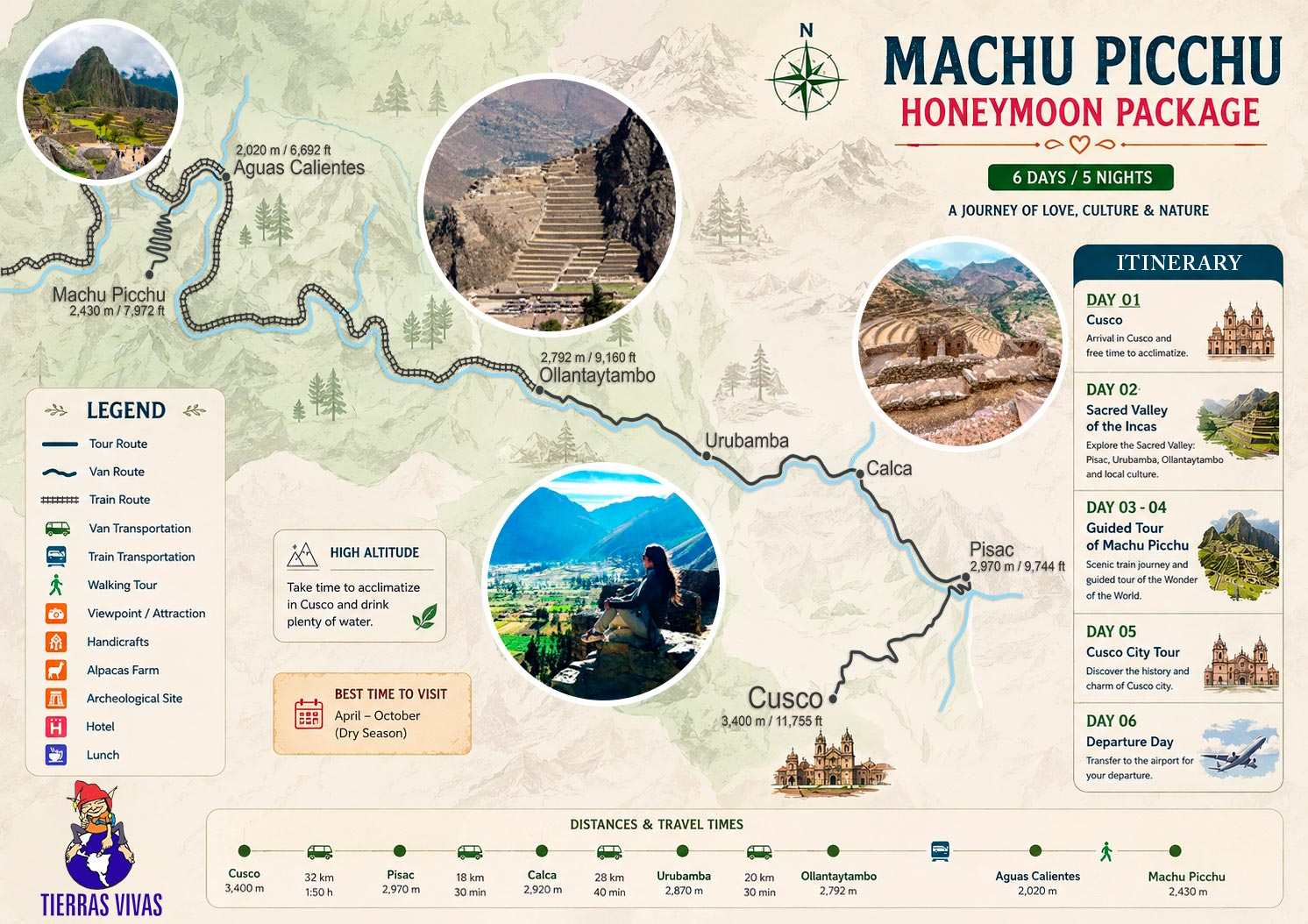
Quick Itinerary
Day 01:: Cusco.
Day 02:: Sacred Valley of the Incas.
Day 03 04:: Guided tour of Machu Picchu.
Day 05:: Cusco city
Day 06:: Departure Day
What Makes This Machu Picchu Honeymoon Unforgettable
- Arrive in Cusco — the ancient Inca capital and one of the most intact colonial cities in South America — and spend your first day letting the altitude, the stone streets, and the centuries of layered history settle in around you.
- Explore the Sacred Valley of the Incas on a private full-day tour: the cliff-top ruins and artisan market of Pisac, lunch in Urubamba, and the towering fortress of Ollantaytambo — where Inca forces defeated a Spanish military advance in 1537.
- Visit Maras, Moray and Chinchero — three of the most distinctive sites in the Cusco region: family-run salt pans unchanged since Inca times, mysterious circular agricultural terraces, and a hilltop village where Inca palace walls support a 17th-century colonial church.
- Board the Vistadome panoramic train from Ollantaytambo — 90 minutes through the cloud forest canyon toward Aguas Calientes, with the Urubamba River below and the vegetation thickening as the train descends toward the Machu Picchu valley.
- Enter Machu Picchu at dawn with a private guide for a two-and-a-half-hour tour of the citadel — the Intihuatana stone, the Temple of the Sun, the Temple of the Three Windows, the Condor Temple — then stay to explore on your own before the afternoon crowds arrive.
- Stay in luxury hotels chosen for their position inside the historic centre of Cusco and directly beside the citadel entrance in Aguas Calientes — all private transfers, bilingual guides, and the Boleto Turístico covering Cusco's main archaeological sites included from USD 1,300.
Machu Picchu Honeymoon Advisor
- Duration: 6 days / 5 nights
- Crew: A Tierras Vivas representative meets you in Cusco and Aguas Calientes. A licensed, bilingual private guide accompanies you throughout the full honeymoon itinerary.
- Accommodation: 5 nights in luxury hotels (4-star and above): Costa del Sol Cusco (Cusco) · Tierra Viva Machu Picchu (Aguas Calientes)
- Meals 4 breakfasts · 2 lunches (Sacred Valley and Aguas Calientes)
- Transportation: Private vehicle for all transfers and day tours · Vistadome panoramic train (Ollantaytambo ↔ Aguas Calientes) · round-trip shuttle bus from Aguas Calientes to Machu Picchu citadel
- Entrance fees included: Machu Picchu entry ticket · Boleto Turístico del Cusco (covers Sacsayhuamán, Qorikancha, Moray, Pisac, Ollantaytambo and more)
- Tailor-made option: Would you like a different duration, additional destinations, or a fully custom itinerary? Contact us at info@tierrasvivas.com and our travel design team will build it for you.
Itinerary Details
Day 01: Cusco — Arrival & Acclimatization
Your Machu Picchu honeymoon begins the moment you land at Alejandro Velasco Astete International Airport in Cusco. A Tierras Vivas representative will be waiting at arrivals to transfer you directly to the Costa del Sol Cusco — a colonial-style property positioned in the historic centre, a short walk from the Plaza de Armas.
Today has no scheduled activities, and that is intentional. Cusco sits at 3,399 metres above sea level — a significant altitude for most international travellers — and the body needs time to adjust before the itinerary properly begins. Rest is the right call.
Coca tea helps more than people expect. It has been used in this part of the Andes for thousands of years — long before the Inca Empire formalised its use — and it genuinely eases the first hours at altitude. The Costa del Sol Cusco can arrange complimentary oxygen to your room on request, which speeds up acclimatization considerably for those who feel the altitude more acutely.
If the afternoon energy allows, step outside. The Plaza de Armas is two minutes on foot — the Cathedral on one side, the Iglesia de la Compañía de Jesús on the other, and the Inca stonework of Loreto Street running behind it. Walk slowly. Tomorrow the itinerary begins in earnest.
Day 02: Sacred Valley of the Incas — Pisac, Urubamba & Ollantaytambo
The first thing you notice leaving Cusco is that the air gets easier. The Sacred Valley of the Incas sits roughly 300 metres lower than the city — enough of a difference to feel, especially on the second morning of acclimatization. Your private car and driver picks you up at the hotel and heads northeast along the valley, where the Urubamba River runs between terraced hillsides and snow-capped ridges.
Pisac
The first stop is Pisac, which divides neatly into two parts. Above the town, the archaeological site climbs the hillside in a series of Inca agricultural terraces — some of the most extensive in the region — with a ceremonial sector and panoramic views over the valley floor that make the uphill walk worthwhile. Below, the town market spreads through the main plaza and surrounding streets: handwoven textiles, alpaca knitwear, carved stone, ceramic work, and silver jewellery made by local artisans. Worth spending time in both halves without rushing either.
Lunch in Urubamba
Midday stop in Urubamba — the valley's main town — for lunch at one of the local restaurants along the river. Time to sit, eat, and let the morning settle before the afternoon.
Ollantaytambo
The afternoon belongs to Ollantaytambo — the most complete surviving example of Inca urban planning, where the original 15th-century street grid, stone water channels, and residential blocks are still in daily use by the families who live there. Above the town, the fortress rises in near-vertical defensive terraces topped by the unfinished Temple of the Sun.
You overnight in Urubamba, in the valley. Tomorrow, Maras, Moray and Chinchero — and in the evening, the train to Machu Picchu.
Day 05: Cusco — A Free Day in the Inca Capital
After Machu Picchu, Cusco rewards a slower pace. Today belongs entirely to you — no transfers, no schedule, no guide required. The city is compact enough to walk, layered enough to spend a full day in, and different enough from what you have already seen to earn its own chapter in the trip.
Cusco was the administrative, religious, and military capital of the Tawantinsuyu — the Inca Empire at its peak — and the Spanish built their colonial city directly on top of it rather than clearing it. The result is a place where 15th-century Inca stonework supports 17th-century baroque churches, and where the cobblestone streets of the historic centre follow the same grid the Inca engineers laid out five centuries ago.
Archaeological sites near Cusco
All four sites are within 15 minutes of the city centre by vehicle and are covered by the Boleto Turístico del Cusco included in your package:
- Sacsayhuamán — A military and ceremonial complex built with limestone blocks weighing up to 130 tonnes, fitted without mortar with a precision that still puzzles engineers. Three parallel zigzagging walls run over 360 metres and have survived every earthquake since the 15th century.
- Q'enqo — A sacred site carved into a single massive limestone outcrop, with underground chambers, carved altars, and channels believed to have been used for ritual and astronomical ceremony.
- Tambomachay — The Temple of Water: a hydraulic complex of stone aqueducts and channels that still carry clean water after more than 500 years of continuous use.
- Puca Pucara — A red granite watchtower on the royal road to the Sacred Valley. Smaller than the others, but worth the stop for the views over the surrounding hillsides at altitude.
Qorikancha — the temple the Spanish built over
Back in the city, the Qorikancha is the sharpest lesson Cusco gives you about what conquest actually looked like. This was the wealthiest temple in the Inca Empire — the Temple of the Sun, its interior walls lined entirely in gold sheeting, housing a golden sun disc and sacred offerings to Inti. When the Spanish arrived, they stripped every gram and sent it to the Crown as tribute. Then, rather than clearing the site, they built the Santo Domingo Church directly on top of the original Inca foundations.
Those foundations are still there. You can see exactly where the Inca stonework ends and the Spanish construction begins — two completely different ideas of permanence, sharing the same ground. The Inca walls, built to flex during earthquakes, have needed no repair. The Spanish additions have required repeated restoration.
Use the rest of the day however it suits you — the Barrio de San Blas, the Mercado San Pedro, a long lunch somewhere with a pisco sour. Tomorrow is your last morning in Peru.
Day 03: Aguas Calientes — Arrival & Afternoon Free
Private car from your hotel in Urubamba to Ollantaytambo station — about 20 minutes along the valley road. From there, the Vistadome panoramic train follows the Urubamba River downstream for 90 minutes through the cloud forest canyon: the walls of rock close in, the vegetation thickens, and by the time the train pulls into Aguas Calientes station, you are at 2,040 metres — nearly 1,400 metres lower than Cusco, and in a different ecological world.
A Tierras Vivas representative meets you at the station. The rest of the day is yours. Aguas Calientes is a small river town built for exactly this kind of afternoon: restaurants lining the water, the thermal baths a short walk from the centre, a waterfall trail that takes about 45 minutes return. Eat well tonight. Tomorrow begins early.
Day 06: Departure — Cusco to Home
Private transfer to Alejandro Velasco Astete International Airport for your flight to Lima and onward international connection.
Six days. Cusco, the Sacred Valley, Machu Picchu. A beginning worth remembering.
If you would like to extend your stay in Peru — Lima, Lake Titicaca, Arequipa, the Colca Canyon — your Tierras Vivas travel designer can add it to your itinerary. Contact us at info@tierrasvivas.com.
Your 6-day Machu Picchu honeymoon at a glance
- 6 days / 5 nights
- 3 destinations
- 100% private tours & transfers
- 1 UNESCO World Heritage Site
- Boleto Turístico Cusco included
- From USD 1,300 per couple
Day 04: Machu Picchu — Inside the Citadel
Early breakfast, then the bus from Aguas Calientes up to the citadel entrance. The road switchbacks through cloud forest, and the gates open at dawn — which is when you want to arrive. At that hour, the mist sits in the valley below the ruins, the light comes in at a low angle across the stonework, and the site is as quiet as it ever gets.
Machu Picchu sits at 2,430 metres above sea level, 122 km from Cusco, in the middle of a subtropical cloud forest that the surrounding mountains keep hidden from the lowlands below. UNESCO designated it a World Heritage Site in 1983 — both for its natural setting and for its archaeological significance — and it remains one of the finest surviving examples of Inca architecture and urban planning anywhere in the Americas.
Your private guide leads a two-and-a-half-hour tour through the citadel: the Intihuatana stone, the Temple of the Sun, the Temple of the Three Windows, the Royal Tomb, the Condor Temple, the agricultural terraces cascading down toward the valley. The Inca built Machu Picchu to work with its mountain — the drainage, the orientation, the stonework fitted without mortar — in a way that has kept the structure intact through five centuries of Andean weather. That precision is visible in every wall you walk past.
After the guided tour, the citadel is yours to explore. The residential sector, the quarry, the lesser-visited eastern terraces — there is more here than two hours covers. When you are ready, the shuttle takes you back down to Aguas Calientes for lunch by the river before the return train to Ollantaytambo and the transfer back to Cusco.
Tomorrow: Cusco city — the last full day.
Included
What's Not Included
- International flights
Flights to and from Lima are not included. Your Tierras Vivas travel designer can recommend routing options on request.
- Domestic flights
Lima–Cusco and Cusco–Lima flights are not included in the base package. Ask your travel designer about adding them.
- Optional mountain tickets at Machu Picchu
Huayna Picchu (Circuit 3A) and Machu Picchu Mountain (Circuit 1A) require a separate ticket — not included in the base price.Approximate cost: USD 80 per person. Slots sell out weeks in advance — book at the same time as your main Machu Picchu entry.
- Meals not listed in the itinerary
All included meals are detailed above. Any additional meals, drinks, or dining outside the itinerary are at your own expense.
- Travel insurance
Not included but strongly recommended — particularly a policy covering medical evacuation at high altitude.
- Gratuities
Tips for guides and drivers are not included. Tipping is common practice in Peru and appreciated — the amount is entirely at your discretion.
- Personal expenses
Souvenirs, optional activities, laundry, minibar charges, and any services not explicitly listed in the itinerary.
What's Included in Your Machu Picchu Honeymoon
- Private airport meet & greet
A Tierras Vivas representative meets you personally at Alejandro Velasco Astete Airport in Cusco — sign with your names, direct transfer to your hotel.
- All airport & inter-city transfers
Private vehicle throughout — no shared shuttles, no waiting for other passengers.
- 5 nights in luxury hotels
Costa del Sol Cusco (Cusco, historic centre) · Tierra Viva Machu Picchu (Aguas Calientes, beside the citadel access)
- All entrance fees
Machu Picchu entry ticket · Boleto Turístico del Cusco — covers Sacsayhuamán, Q'enqo, Tambomachay, Puca Pucara, Pisac, Ollantaytambo, Moray and more.
- Private bilingual guides
Licensed, MINCETUR-certified guides exclusively assigned to you — Sacred Valley, Cusco and Machu Picchu. No shared groups.
- Meals as per itinerary
5 breakfasts · 1 buffet lunch in the Sacred Valley · 1 lunch in Aguas Calientes
- Round-trip Vistadome train
Vistadome panoramic train tickets — Ollantaytambo ↔ Aguas Calientes, with panoramic roof windows through the cloud forest canyon.
- Round-trip shuttle bus
Return bus from Aguas Calientes to the Machu Picchu citadel entrance — included both ways.
Essential Information
Before You Go: What to Pack for Your Peru Honeymoon
This itinerary moves between three distinct environments — the high Andes of Cusco at 3,399 metres, the Sacred Valley floor at around 2,800 metres, and the subtropical cloud forest of Aguas Calientes at 2,040 metres. Each has different temperatures and conditions. Packing for all three is easier than it sounds, and none of it requires specialist equipment — this is a hotel-based trip, not a trekking expedition.
A medium suitcase or a structured carry-on works well for the city stages. For the day visits to Machu Picchu and the Sacred Valley, bring a small daypack — you will leave your main luggage at the hotel.
Documents & essentials
- Passport — original plus a digital and physical copy
- Travel insurance documents: A policy covering medical evacuation at high altitude is strongly recommended
- Flight tickets — printed or digital
- Tierras Vivas service voucher: Sent to you by email before departure
- Cash in USD or Peruvian soles, plus a credit card: ATMs available in Cusco and Aguas Calientes; cards widely accepted in hotels and restaurants
- Entry visa and vaccination certificate if applicable
Clothing — layers are the key
- Comfortable trousers and shorts for daytime walks
- Warm mid-layer: fleece or wool sweater. Cusco evenings drop below 10°C even in summer
- Light waterproof jacket or poncho:Weather changes quickly at altitude — rain can arrive without warning, especially in the Sacred Valley and at Machu Picchu
- Comfortable walking shoes or light trekking shoes: Machu Picchu has uneven stone paths — trainers work but a sole with grip is better
- Swimsuit: For the thermal baths in Aguas Calientes — one of the best ways to spend the afternoon before Machu Picchu
- Hat or cap — for sun at altitude and cold at night
Health & sun protection
- High-SPF sunscreen: UV radiation is significantly stronger at altitude — SPF 50 recommended
- Sunglasses — polarised preferred
- Insect repellent with minimum 20% DEET: Relevant for the Aguas Calientes stage; not required in Cusco or the Sacred Valley
- Altitude sickness medication if prescribed: Consult your doctor before travel; coca tea and rest help significantly on arrival in Cusco
- Lip balm and moisturising cream: High-altitude air is very dry
Daypack essentials
- Reusable water bottle: Plastic single-use bottles are not permitted inside Machu Picchu — bring a refillable one
Camera and charger: Battery drain accelerates in cold conditions — carry a spare or a power bank
Small snacks for the citadel visit: No food is permitted inside Machu Picchu itself — eat before entering and after returning to Aguas Calientes
Small towel and toiletries for the thermal baths
Plastic bottles at Machu Picchu: single-use plastic bottles are prohibited inside the citadel. Bring a reusable bottle — water refill points are available at the entrance.
Machu Picchu Honeymoon Map
BOOK NOW


