
In Cusco, Holy Week is not experienced like in the rest of Peru. The city that was the capital of the Tahuantinsuyo welcomes the Passion of Christ with the same intensity with which it once celebrated its own gods, and the result is a religious festival like no other. The city streets are filled with platforms carried among petals and incense, the bells of its colonial churches ring without rest, and thousands of people from Cusco go out to accompany each procession with great devotion.
That mix is not by chance. When the Spanish built their temples on the foundations of Inca buildings, they did not just put stone on stone: they placed one faith over another. That is why figures like the Lord of the Earthquakes, the patron of the city, live together to this day with symbols and practices that come straight from the Andean world. Each Holy Week procession in Cusco carries that historical weight, and it is exactly there where its uniqueness lies compared to any other celebration in the country.
To experience Holy Week in Cusco is to understand that faith here is also served at the table, walked in a pilgrimage until dawn, and celebrated with fire on the most sacred night of the year. In this guide we tell you what happens day by day during Holy Week 2027, where to place yourself to experience each procession up close, what dishes you must try, and everything you need to know to plan your trip to Cusco on these dates.
How is the Holy Week festival experienced in Cusco?
Holy Week in Cusco is not limited to a single day of procession: it is a seven-day journey where each one has its own pace, its own ceremony, and its own meaning within the Andean religious calendar. Unlike other cities in the country, here each day has a clear main character, and the entire city (from its colonial temples to its cobblestone streets) is organized around it.
This is what happens, day by day:
- Palm Sunday – The palms are blessed and the Lord of Triumph, patron of the city, goes out in a procession.
- Holy Monday – The main day of the week: the Lord of the Earthquakes goes through the streets of the Historic Center towards the Main Square.
- Holy Tuesday and Holy Wednesday – Days of reflection, with masses and preparations before the Easter Triduum.
- Holy Thursday – Foot washing ceremony and night pilgrimage to the Seven Churches.
- Good Friday – Way of the Cross from very early and solemn processions throughout the day.
- Holy Saturday – Easter Vigil, celebrated by candlelight until midnight.
- Easter Sunday – Cusco celebrates the Resurrection with music, shared food, and a festive mood that closes the week.
During these days, the city changes: the streets are covered with flowers and ritual carpets, the churches open their doors until late at night, and Catholic prayers and practices that come directly from the Andean worldview live side by side (shoulder to shoulder). For the traveler, it is one of the most authentic experiences that Cusco offers, but also one of the most crowded: if you plan to visit the city on this date, booking in advance is a must.
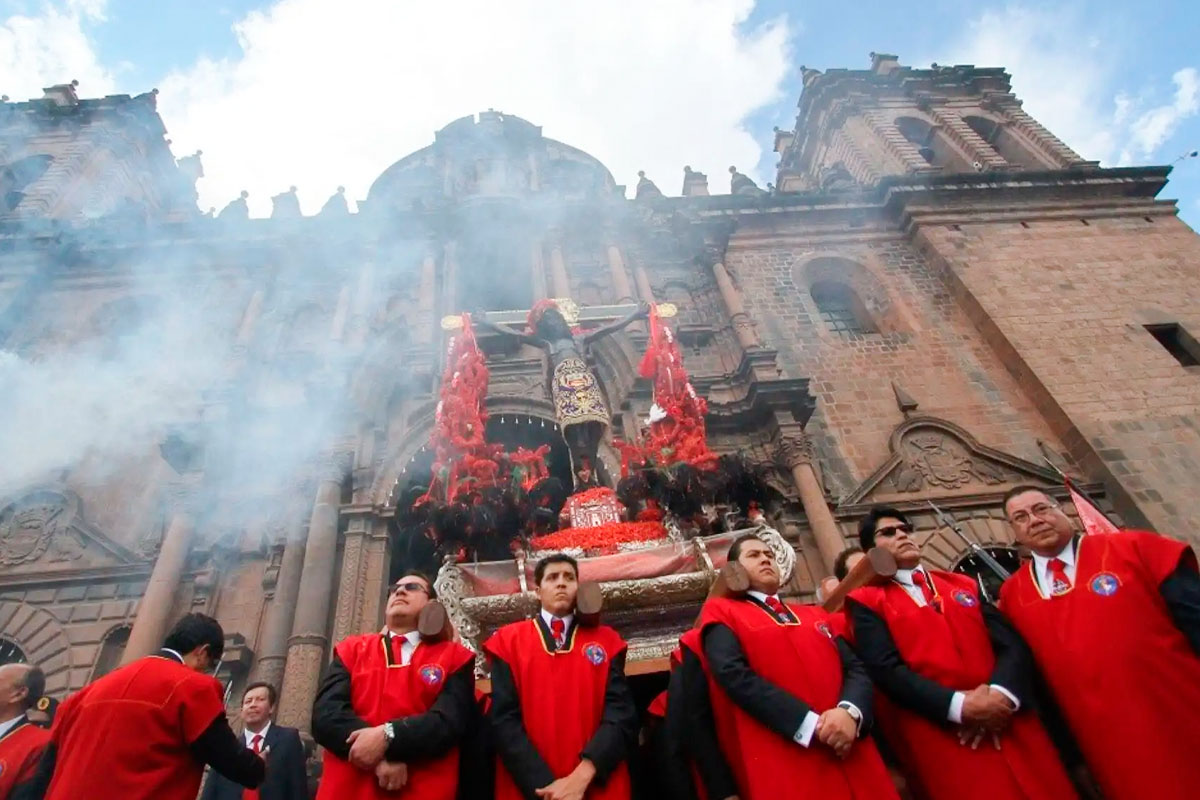
Dates for Holy Week in Cusco 2027
Holy Week does not have a fixed date in the calendar: it is calculated every year based on the lunar cycle, taking as a reference the first Sunday after the first full moon after the spring equinox. That is why it can fall in March or April, and 2027 will be an early year.
In 2027, Holy Week in Cusco will be celebrated from Sunday, March 21 to Sunday, March 28, with the following calendar:
- Palm Sunday – March 21
- Holy Monday – March 22
- Holy Tuesday – March 23
- Holy Wednesday – March 24
- Holy Thursday – March 25
- Good Friday – March 26
- Holy Saturday – March 27
- Easter Sunday – March 28
If you are planning your trip, keep in mind that Holy Monday (procession of the Lord of the Earthquakes) and Easter Sunday are the busiest days in the city, so hotels and tours usually sell out weeks (even months) in advance.
This is how the day-to-day of Holy Week in Cusco is experienced
Each day of Holy Week in Cusco has its own character; there are days of reflection and silence, and days where the whole city goes out to the streets to join a procession that lasts for hours. Knowing what happens on each one allows you to plan your visit calmly, choose at what times you want to be in the front row, and at which ones you prefer to just let yourself be carried away by the atmosphere.
Below is a day-by-day tour of the Cusco Holy Week: its rituals, its history, and the best places to experience each procession up close.
1. Palm Sunday: Blessing of the palms and the beginning of reflection
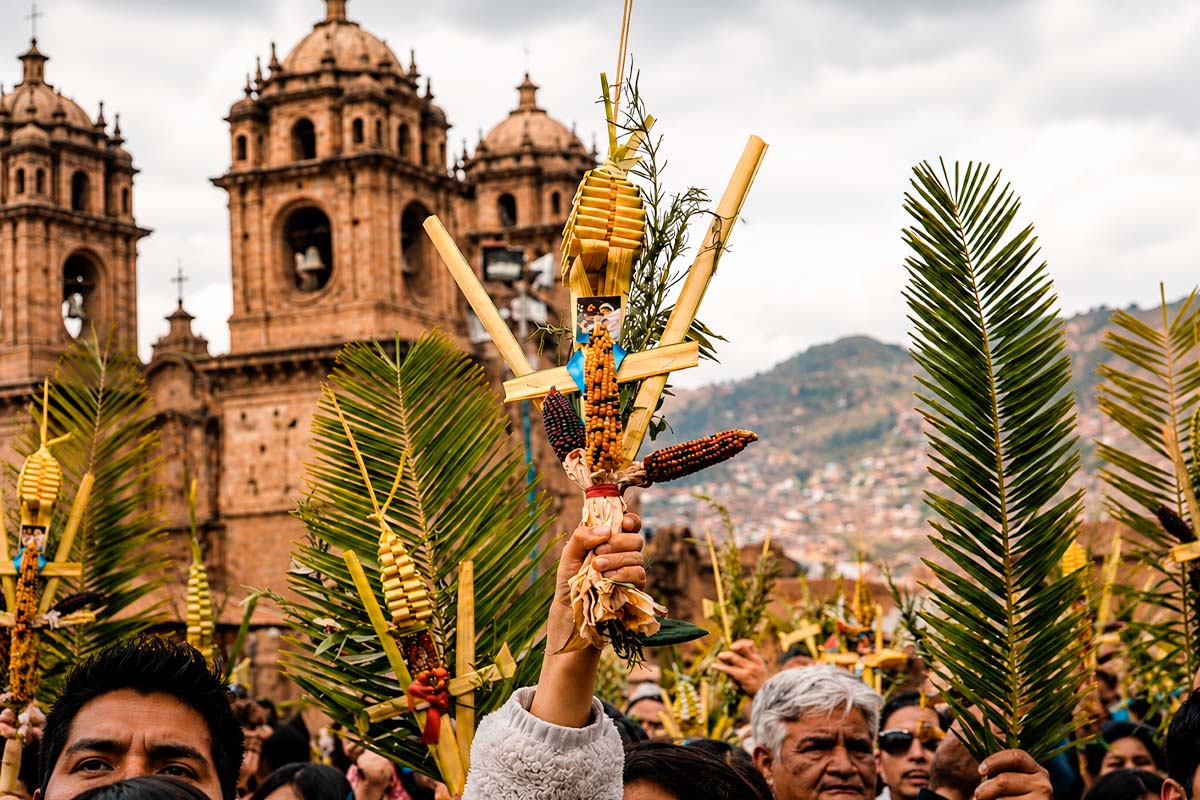
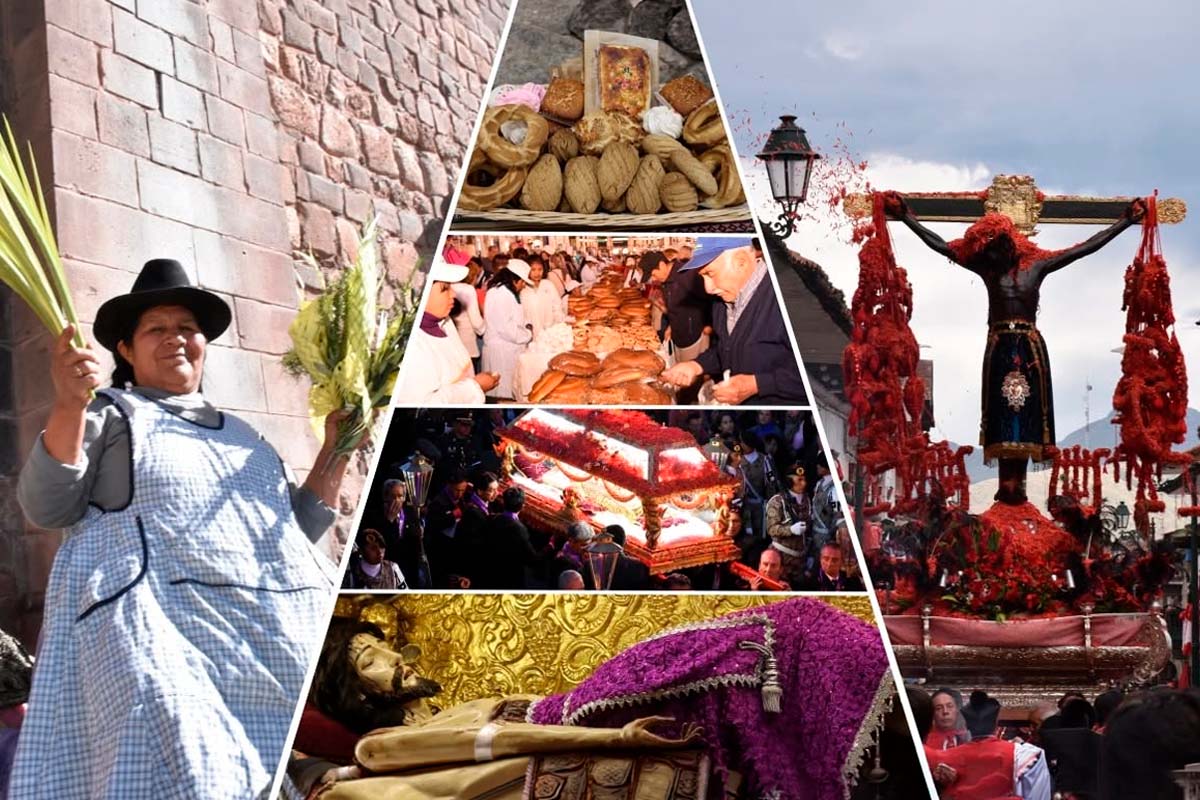
Holy Week in Cusco opens with Palm Sunday, the day when the city remembers the entry of Jesus into Jerusalem. Early on, the faithful gather in the Cathedral and in the main churches of the Historic Center with woven palms and olive branches, which are blessed before the main mass. It is a day of welcoming, marked by color and by a calm that contrasts with the intensity that the week will take in the following days.
In the afternoon, the image of the Lord of Triumph, patron of the city, goes out in a procession, touring the streets around the Main Square accompanied by hundreds of people from Cusco. If you want to see it without difficulty, the Main Square itself and the Mantas and Plateros streets are the most comfortable spots: they offer good visibility and do not gather as many people as the main days of the week, so it is a good first contact with the atmosphere of the Cusco Holy Week before Holy Monday arrives.
2. Holy Monday: the Lord of the Temblores goes out to the streets
Holy Monday is, without a doubt, the most awaited day of Holy Week in Cusco, and also the one that gathers the largest number of faithful and visitors in a single point of the city. From very early, the Main Square prepares to receive the Taytacha of the Temblores, sworn patron of Cusco, whose image goes out in a procession from the Cathedral and becomes the center of the day.
History of the Lord of the Temblores
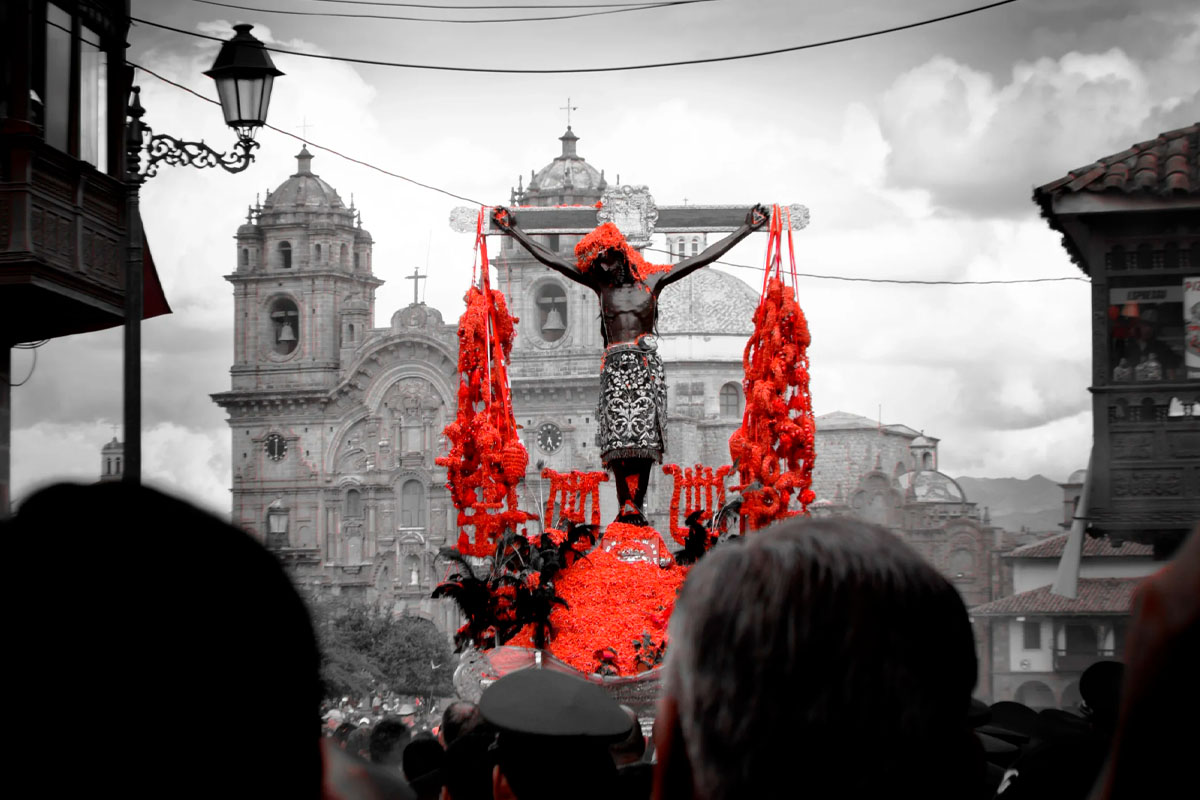
The devotion to this figure has a history of centuries. It is a Christ carved in the 16th century that, according to tradition, arrived in Cusco as a gift from King Charles V of Spain. His fame as a protector was born in 1650, when a strong earthquake shook the city and the locals took the image out to the streets in an emergency procession, asking for the tremors to stop. Tradition says that this happened, and from that moment the Christ was named patron and guardian of Cusco against natural disasters. Over the centuries, the constant smoke from the candles darkened the carving, which is why today he is also known by the name of Dark Christ.
The Holy Monday Procession
The procession itself is a display of faith and color. The image moves forward on litters carried by devoted people dressed in red cloaks (a color that represents the passion of Christ and that, at the same time, connects with the Andean symbols of power and the sacred). As he passes, the faithful throw ñucchu flowers (a wild red flower). As the procession moves forward, chants and hymns are sung in both Spanish and Quechua, a detail that sums up very well what Holy Week in Cusco represents: two religious traditions living together in a single celebration.
To experience this moment up close, the Main Square (especially the area around the Cathedral, where the route begins and ends) is the point of greatest intensity, although also the most crowded. If you prefer to see it with a little more space, the Mantas and Marquez streets offer good visibility with fewer crowds. Another option, if you are looking for a clear view of the entire route, are the balconies and terraces of the restaurants around the square; they usually fill up fast, so it is a good idea to book a table several days in advance. Whatever the chosen spot, the important thing is to arrive early (ideally mid-morning) because, without exception, this is the most crowded day of the entire Cusco Holy Week.
3. Holy Tuesday and Holy Wednesday: the days of reflection before the Easter Triduum
After the intensity of Holy Monday, the city slows down. Holy Tuesday and Holy Wednesday are quieter days, meant for reflection and spiritual preparation before the Easter Triduum begins. There are no large processions going through the streets, and the atmosphere in Cusco becomes more withdrawn: the churches of the Historic Center stay open for masses and confessions, and many faithful use these days to visit different temples in the city as part of their personal preparation for Holy Week.
For the traveler, these two days are a good chance to explore Cusco calmly, without the crowds that you will find on Holy Monday or Good Friday. It is the ideal time to carefully tour the Cathedral, the colonial churches in the center, or even take a short trip outside the city, knowing that on Holy Thursday the religious activity (and the crowds) will return with force.
4. Holy Thursday: between the altar and the mountain
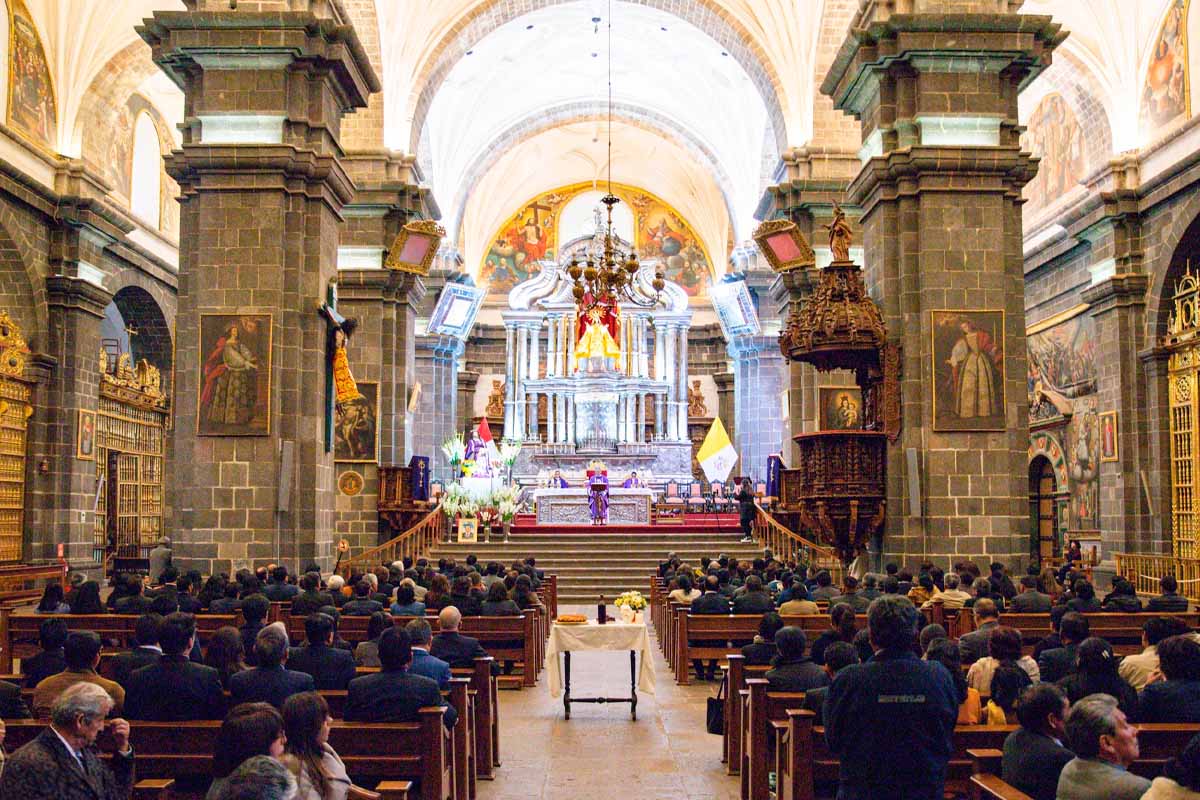
Holy Thursday marks the start of the Easter Triduum and is, along with Holy Monday, one of the most meaningful days in the Cusco Holy Week. Unlike the procession of the Lord of the Temblores, here the main focus is not on a single image, but on a set of rituals that are done throughout the afternoon and night, and that connect the Catholic faith with the daily life of the city.
Everything starts at dusk, between 5 and 7 in the evening, with the Procession of the Blessed Sacrament. It has a detail that makes it different from any other procession of the week: it is led by the civil authorities of Cusco (the mayor and the prefect, among others) along with the religious community, in a century-old tradition that represents the union between the civil power and the faith of the people. As it moves forward, the main churches in the center open their doors to celebrate special masses, including the Cathedral, the Church of the Society of Jesus, and the Church of San Francisco, three of the most representative temples of Cusco's colonial architecture.
About the foot washing ceremony
At the same time, inside the Cathedral, one of the most moving ceremonies of the day is held: the Washing of the Feet. Led by the bishop of Cusco, this ceremony represents Christ's gesture of humility towards his disciples. In the past, it was done with twelve people in a situation of begging; today it honors twelve older people, keeping the original meaning of the ritual intact: service, humility and compassion.
The pilgrimage to the Seven Churches
Late at night, the city lives its most mystical moment of the day: the Pilgrimage to the Seven Churches. It is a walking tour through seven temples in the historic center, where the faithful stop at each place to think in front of the so-called "Altars of Sorrow", lit with candles and flowers. The route usually includes:
- Cusco Cathedral (Main Square)
- The Society of Jesus (Main Square)
- Church of San Francisco (San Francisco Square)
- Church of La Merced (Mantas Street)
- Church of Santa Clara (Santa Clara Street)
- Church of San Pedro (San Pedro Market)
- Church of San Blas (San Blas Neighborhood)
It is a walk that combines faith, colonial art, and history, since a large part of these temples were literally built on top of Inca foundations.
If you plan to do this pilgrimage, it is a good idea to leave early, since several churches close their doors around 10 at night. Also bring something warm: Cusco nights are cold even in March. And take advantage of the night to try some of the typical food of these days, like the soup that is traditionally served on Good Friday or the symbolic banquet of the 12 dishes, which we will talk about later in this guide.
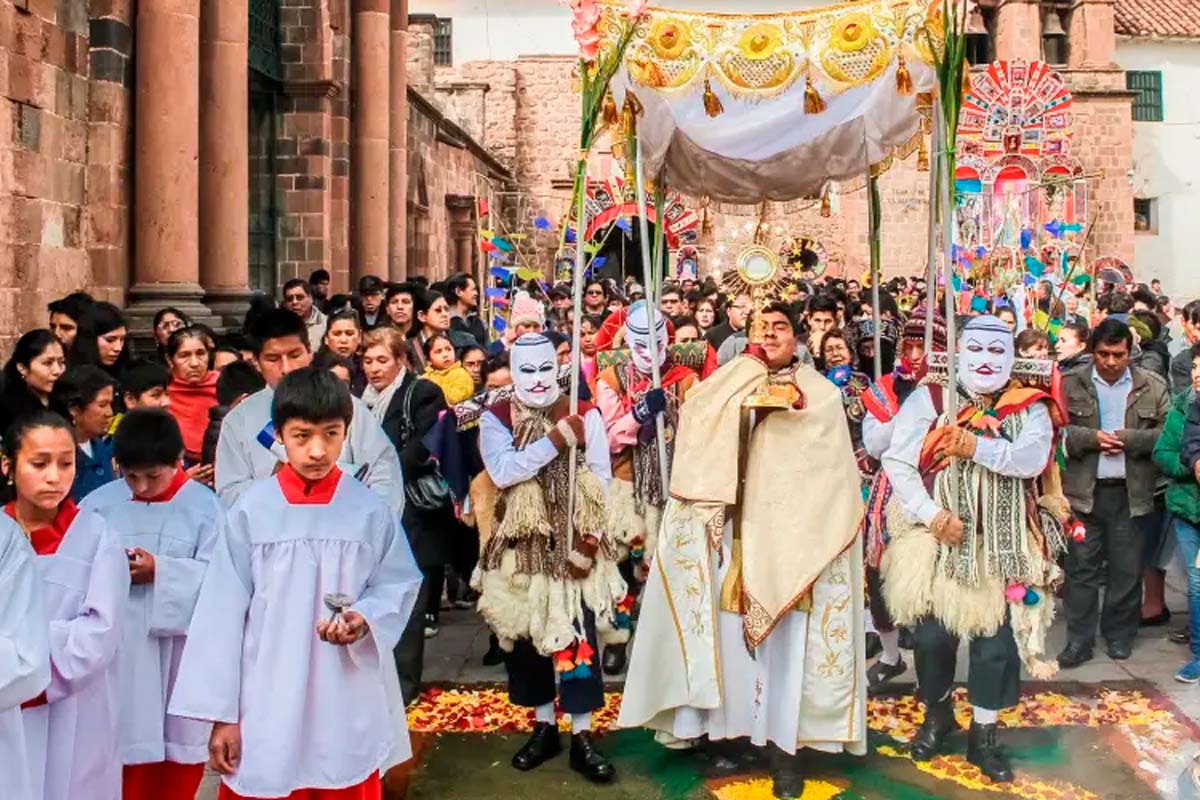
5. Good Friday: The Stations of the Cross in Sacsayhuaman and the table of the 12 dishes
Good Friday is one of the most intense days of the Cusco Holy Week, but with a completely different character: here the main focus moves from the squares in the center to the hills that surround the city, and from the processions to the family table.
The Stations of the Cross at dawn
Everything starts at dawn, long before the sun comes up. Different columns of faithful leave from several churches in the historic center towards Sacsayhuaman, recreating on foot Christ's path to Calvary. It is a silent pilgrimage, lit only by flashlights and candles, that ends with the sunrise over the city, one of the most photographed, although less known, moments of all the Holy Week in Cusco.
There are several possible routes, and each one has its own character:
| Starting point | Destination | Approx. time | What makes it stand out |
|---|---|---|---|
| San Francisco Church | Sacsayhuaman | 4:00 a.m. | The oldest and most crowded route, traditionally led by the Franciscan brotherhoods |
| La Almudena Church | Muyuc Orqo | 3:30 a.m. | More physically demanding route, followed mostly by local devotees |
| San Sebastian Parishes | Alto Qosqo | Before dawn | Family-oriented pilgrimage, with offerings that mix the Andean and the Catholic |
If you plan to join, bundle up: at that time the temperature in Cusco drops a lot. Bringing thermal clothes and something to cover yourself from the wind helps a lot, and it does not hurt to bring something hot to drink on the way.
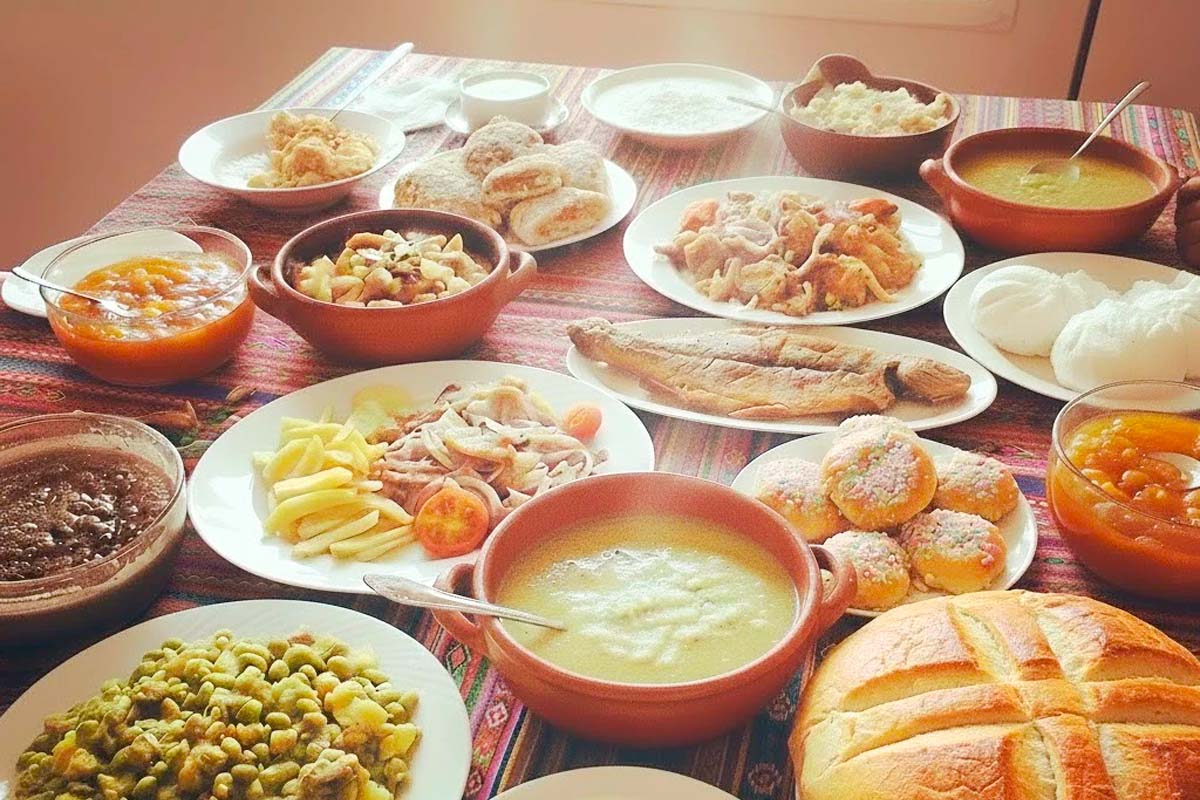
The 12 dishes of Holy Week
Late in the morning, the tradition moves to the table. In Cusco, families prepare a feast made up of twelve dishes, one for each apostle, in a food celebration that recreates the Last Supper in its own way. The only rule is that not a single one can be missing or left over: there are always twelve, and always without red meat, respecting the fasting of Holy Week.
The combination changes from family to family, but usually keeps the same structure: three soups, four main dishes, and five desserts. Among the most common are the lawa (a corn cream with huacatay), the shrimp chupe, the ceviche, the fried trout with rice, and stews made with pumpkin and tarwi. For the sweet ending, they usually do not miss the mazamorra, the rice pudding, the suspiros and the maicillos.
It is a tradition that is lived behind closed doors, but several restaurants in the historic center offer their own version of the 12 dish menu during these days, so, if you travel through the city, you can still try it. In the afternoon, the city returns to its solemn tone: the Virgin of Sorrows, the Holy Sepulchre, and the relic of the True Cross go out in a procession, in a path full of reflection that marks the end of the longest (and most complete) day of all the Holy Week in Cusco.
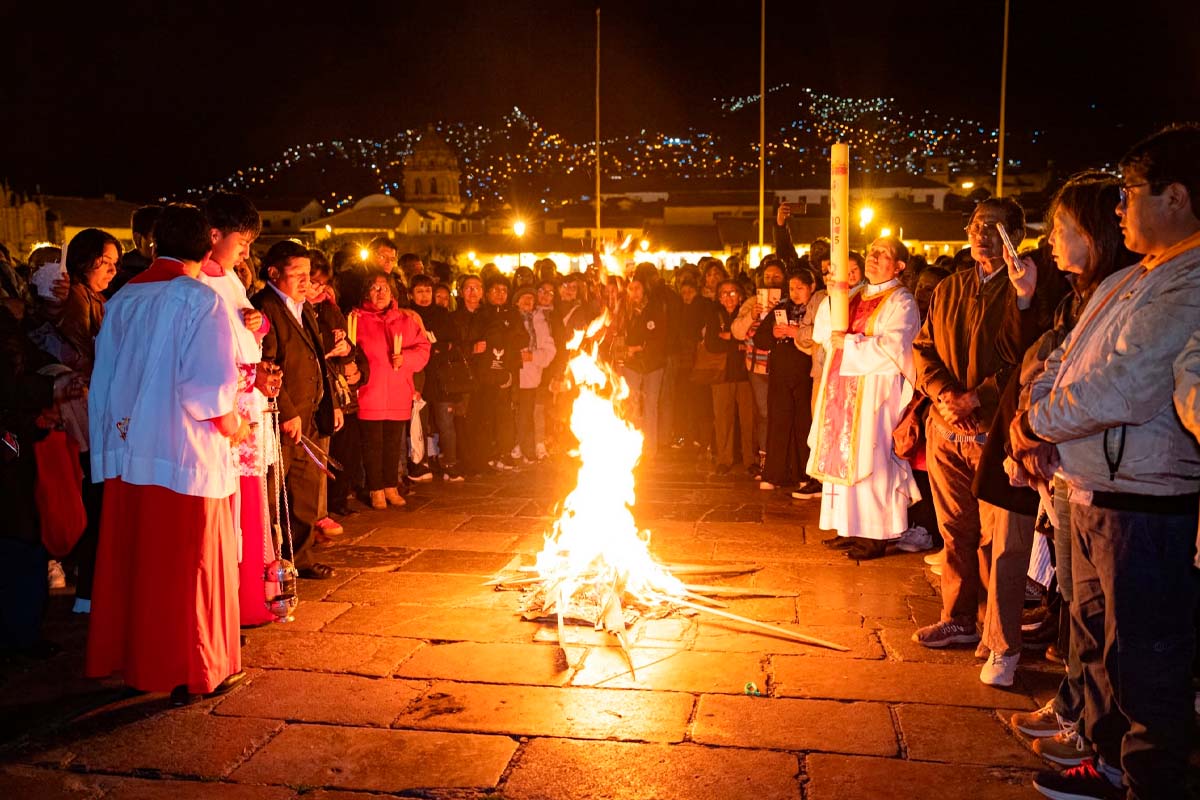
6. Holy Saturday: the Easter Vigil and the new fire
After the reflection of Good Friday, the city prepares for its most sacred night. Holy Saturday passes calmly during the day (many families are still finishing enjoying the 12 dishes or resting from the early morning of the Stations of the Cross), but when night falls, Cusco fills with light and devotion again with the Easter Vigil.
The ceremony starts around 8 at night and lasts until midnight, with the Cathedral, the Church of the Society of Jesus, and the Church of San Francisco as the main celebration spots. The most symbolic moment arrives with the blessing of the new fire: the priest lights the Easter candle, and from that single flame, thousands of candles are lit one by one among the people attending. After days of liturgical silence, the bells ring loudly announcing the resurrection, in one of the most emotional moments of the whole week.
For the visitor, the Easter Vigil is a good alternative to the crowded processions of previous days: it is experienced inside the temples, with a more intimate and less crowded atmosphere than Holy Monday or Good Friday, although it is still a good idea to arrive a little early to get a good spot inside the church.
7. Easter Sunday: the celebration of life returns to Cusco
Easter Sunday closes Holy Week in Cusco with the sharpest contrast of the whole week: after days of reflection, fasting, and solemnity, the city bursts into a celebration full of color, music and shared food.
The day starts very early, between 5 and 7 in the morning, with the Easter mass in the Cathedral, the Church of the Society of Jesus, and the Santo Domingo temple (built on the old Coricancha), at the time that recalls the moment when the empty tomb was discovered. The announcement of "Christ has risen!" and the festive ringing of the bells mark the most emotional point of this mass, accompanied by the smell of incense and flowers in all the temples of the center.
Around 10 in the morning, the image of the Risen Christ goes out in a procession, traveling through the streets of the historic center accompanied by live bands, dancers, and faithful people with flowers in hand, in a completely different atmosphere from the more solemn processions of previous days. At the same time, squares like San Francisco and San Pedro fill up with food fairs and performances of huaynos and folk dances, turning the center of Cusco into a great popular party.
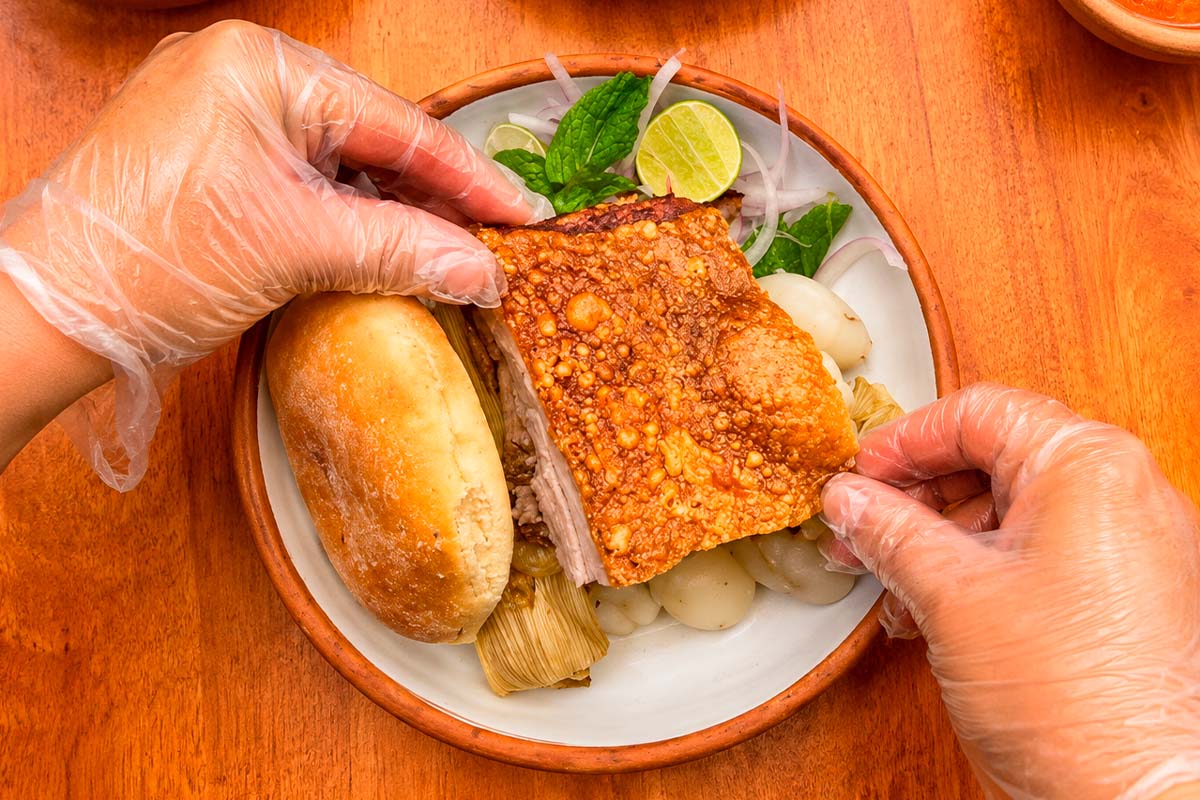
In the houses, families gather for the Easter feast: baked piglet or lamb (the meats that were forbidden during Lent), Cusco tamales, and anise donuts or biscuits, many of them blessed during the mass. It is the perfect closing for a week that combines Catholic faith, Andean heritage and a food identity that is not experienced at any other time of the year.
Holy Week food in Cusco
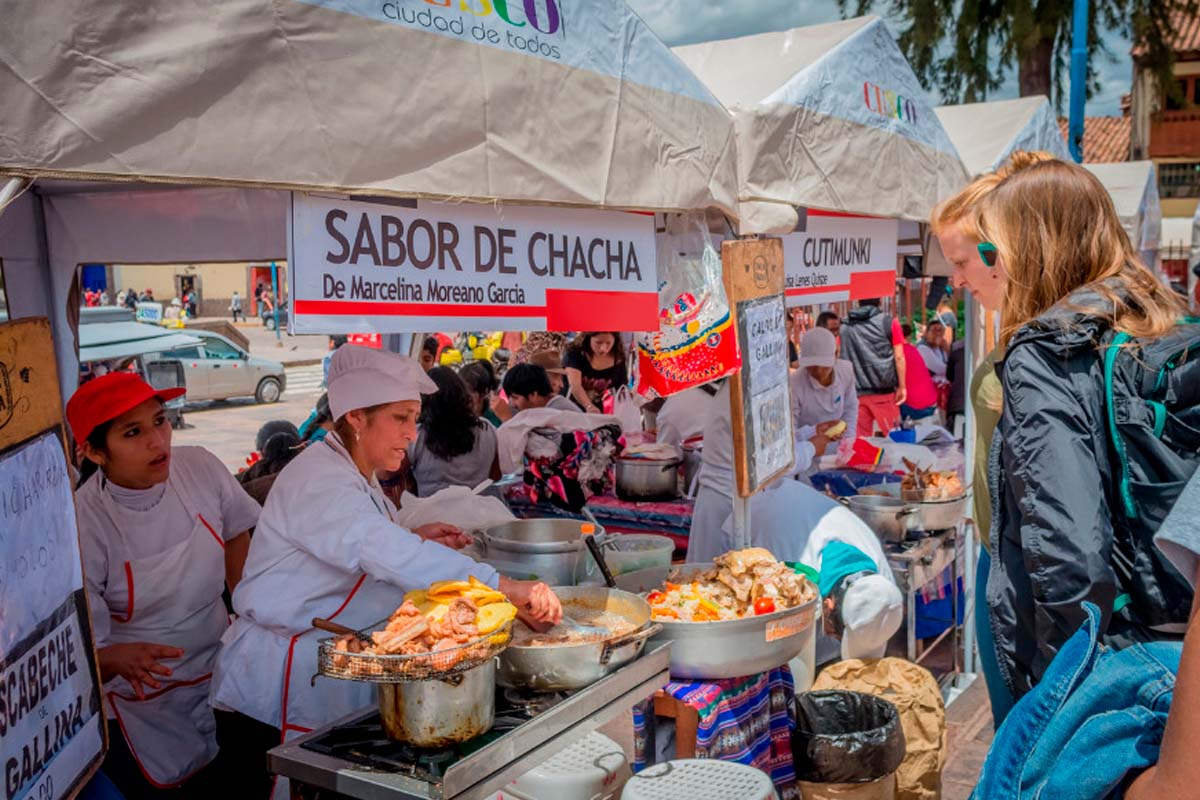
Food is, along with the processions, one of the main stars of Holy Week in Cusco. It is not just about the 12 dishes of Good Friday or the Easter Sunday feast, throughout the whole week, the city follows a food calendar, marked by Catholic fasting and by ingredients that are only prepared at this time of the year.
A cuisine without red meat
The base of the Holy Week food in Cusco is avoiding red meat, especially between Good Friday and Holy Saturday. In its place, the main ingredients are fish, river seafood, beans, and a great variety of dishes made with corn, pumpkin, and quinoa. It is not a strict diet without flavor: on the contrary, it is one of the seasons of the year where Andean food shows more creativity, exactly because it has to solve a full menu without using its most common ingredients.
Beyond the 12 dishes
Even though the 12 dish feast on Good Friday is the main course of the week, there are other dishes that appear on different days:
- Hot purple corn drink with empanadas: A hot drink, a must-have in the early mornings of the Good Friday Way of the Cross. It is sold in street carts near churches and pilgrimage routes.
- Good Friday Soup: A light dish made of fava beans, wheat, or quinoa, that many families serve before the strictest fast of the day.
- Holy Week Fritters: Sweet fried dough, covered in cane sugar honey, which are sold in street stalls during the whole week.
- Corn beer and strawberry drink: Although they are year-round drinks, during these dates they go with family gatherings after the processions.
The Sunday Easter feast
Easter Sunday breaks the meat restriction: baked pork and lamb return to the table after Lent, accompanied by Cusco tamales and sweet breads with anise, many of them blessed during the resurrection mass. It is, literally, the point where Cusco food goes from fasting to plenty in a single day.
Practical tips for traveling to Cusco during Holy Week
Living Holy Week in Cusco is a different experience from visiting the city at any other time of the year, but it also requires a bit more planning. These are the points that make the biggest difference between a smooth trip and one full of surprises.
- Book in advance
March falls into the high booking season for Holy Week, and hotels in the historic center fill up quickly. The same happens with restaurants that offer the 12 dish menu and with tours to Machu Picchu or the Sacred Valley, which usually have less availability on these dates. If you already have your travel dates set, it is best to secure your lodging and activities at least two or three months in advance. - Prepare for closed streets
Throughout the week, and especially on Holy Monday and Good Friday, several streets in the historic center close to traffic for the processions, often without exact prior notice about the time. If you have tours or transfers scheduled on those days, add extra time to get to your meeting point, and keep in mind that walking is usually faster than moving by car through the center during those hours. - Pack for changing weather
March is in the transition between the rainy season and the dry season in Cusco, so it is common to have strong sun during the day, some rain in the afternoon, and noticeable cold at night, especially in the early mornings of the Good Friday Way of the Cross. The most practical thing is to dress in layers: a light piece of clothing for the day, a light raincoat, and something warm for the nights and early mornings. - Consider the altitude
Cusco is at more than 3,300 meters above sea level, so altitude sickness can affect you in the first few days. This is especially important if you plan to take part in the Way of the Cross to Sacsayhuaman, since it involves walking uphill in the early morning. Arriving with one or two days to spare before Holy Week, drinking plenty of water, and avoiding alcohol at the start helps a lot with getting used to the altitude. - Experience the processions with respect
The Holy Week processions and ceremonies are not a tourist show: they are deeply rooted acts of faith for the people of Cusco. You can take pictures and join the atmosphere without a problem, but it is best to avoid blocking the path of the floats, talking loudly during the most serious moments, or dressing very casually inside the churches. - Take the chance to combine with other destinations
If your trip is not limited only to Holy Week, these days are also a good chance to visit the Sacred Valley of the Incas or do a short hike like the 2 day Inca Trail, as they usually have less tourist movement than in the high dry season. However, keep in mind that Machu Picchu receives more visitors than usual on these dates, so booking the train and the ticket in advance is just as important.
Holy Week vs. other dates in Cusco: is it worth traveling at this time?
If you are deciding when to travel to Cusco, it is natural to ask yourself if Holy Week is the best time or if it is better to wait for another date in the year. The answer depends on what kind of experience you are looking for, so here we compare Holy Week with the other two most popular times to visit the city.
Holy Week vs. dry season (May to September)
The dry season is the most chosen by travelers because the weather is more stable: it almost never rains, the skies are usually clear, and hikes like the Inca Trail are more predictable in terms of conditions. The downside is that it is also the season with the largest tourist crowds in Cusco and Machu Picchu, with higher prices for hotels and tours.
Holy Week, on the other hand, offers something the dry season does not have: a city living its most important religious celebration of the year, with processions, rituals, and food that you will not find at any other time. The weather is less predictable (there is still some rain), but in return, you get a much deeper cultural experience.
Holy Week vs. Inti Raymi (June 24)
Inti Raymi is the other great celebration in Cusco, but with completely Inca roots: a recreation of the festival of the sun that takes place in Sacsayhuaman with hundreds of actors and a large-scale setup. It is more visual and "spectacular" in the tourist sense, but also more crowded and with tickets that you have to buy well in advance.
Holy Week has an opposite character: it is not a recreation or a show put on for tourism, but a living celebration that the people of Cusco themselves star in as part of their faith. If you are looking to witness something private and authentic, without a stage or a script, Holy Week usually leaves a more genuine impression than Inti Raymi.
So, is it worth traveling during Holy Week?
If your priority is perfect weather for trekking or landscape photography, the dry season is still the safest option. But if what you are looking for is to truly understand the cultural identity of Cusco (that unique mix between Catholic faith and Andean worldview), Holy Week is probably the time of the year when the city is most true to itself. Just go prepared: it is also one of the busiest weeks of the year, so the early planning we talked about in the previous section is not optional, it is necessary.
Frequently asked questions about Holy Week in Cusco 2027
- When is Holy Week in Cusco in 2027?
Holy Week 2027 is celebrated from Sunday, March 21 to Sunday, March 28, starting with Palm Sunday and ending with Easter Sunday. - What is the most important day of Holy Week in Cusco?
Although Holy Thursday, Good Friday, and Easter Sunday are central in the whole Catholic world, in Cusco, Holy Monday has its own weight thanks to the procession of the Lord of the Earthquakes, one of the most important religious events in the city. - Is it a good time to visit Cusco?
Yes, especially if you are interested in experiencing the cultural identity of the city beyond traditional tourism. The only point to keep in mind is that, since it is one of the busiest weeks of the year, it is a good idea to book lodging, restaurants, and tours well in advance. - Does Holy Week affect the visit to Machu Picchu?
It is not suspended or closed, but it does receive more visitors than usual around these dates, so train tickets and entrance tickets to the sanctuary tend to sell out faster than at other times of the year. - What clothes should I bring for Holy Week in Cusco?
Clothes in layers are the best option: something light for the day, a light raincoat for the occasional rains in March, and a warm jacket for the nights and, especially, for the early morning of the Way of the Cross on Good Friday. - Can you take part in the processions as a tourist?
Yes, any visitor can watch and join the processions. The important thing is to do it with respect: avoid blocking the path of the floats, keep a proper tone during solemn moments, and dress properly if you are going to enter the churches. - What food can I not miss if I travel during Holy Week?
The 12-dish feast on Good Friday is the most typical food experience of the week. If you prefer something simpler, the api with empanadas in the early mornings of the Way of the Cross and the chancaca fritters are more accessible options during the rest of the days.
Book your Holy Week experience in Cusco
Experiencing Holy Week in Cusco is understanding, firsthand, why this city continues to be the spiritual heart of the southern Andes. Eight days of processions, history, faith, and a food scene that only exists at this time of the year, in a setting that combines Inca stone and colonial architecture like nowhere else in Peru.
If you already have your dates set for March 2027, this is the time to start planning: book your lodging in the historic center, secure your tickets to Machu Picchu in advance, and take the chance to combine your trip with the Sacred Valley or a short hike like the 2 day Inca Trail. Write to us and we will help you put together an itinerary that allows you to experience Holy Week without missing what you are most interested in knowing about Cusco.
You might also be interested in


